In American cocktail recipes, oz usually means U.S. fluid ounces, a measure of volume. You may also see milliliters (mL), parts, dashes, and barspoons. This guide explains how to read those measures and keep the proportions of your drink intact.
Why the unit matters
A number without its unit is incomplete. Confusing a fluid ounce with an ounce of weight, or treating a dash as a fixed milliliter amount, can change the drink before you even start mixing. Choose one measuring system for a recipe and use it consistently.
Cocktail measurement chart: ounces to mL
Both fluid ounces and milliliters measure volume. One U.S. fluid ounce is about 29.57 mL. For everyday cocktail mixing, 1 fl oz ≈ 30 mL is a convenient rounded conversion. It is not an exact equality.
| U.S. measure | Rounded metric equivalent |
|---|---|
| 1/4 fl oz | 7.5 mL |
| 1/2 fl oz | 15 mL |
| 3/4 fl oz | 22.5 mL |
| 1 fl oz | 30 mL |
| 1 1/2 fl oz | 45 mL |
| 2 fl oz | 60 mL |
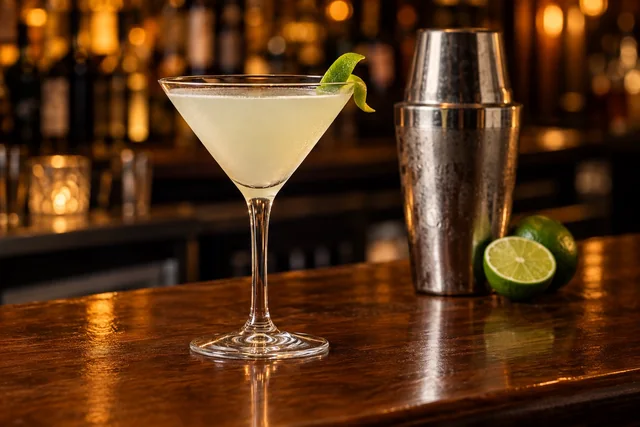
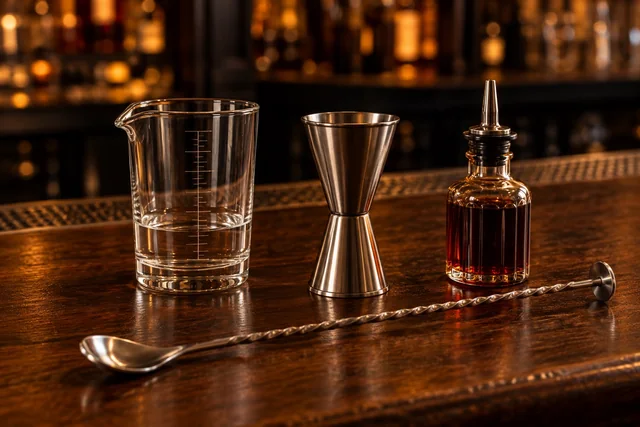
These are practical rounded equivalents. For example, our Daiquiri uses 45 ml white rum, 30 ml lime juice, and 15 ml simple syrup. You could measure it as approximately 1 1/2, 1, and 1/2 U.S. fluid ounces using an ounce-marked jigger. Keep the same approximation across the whole drink.
If a recipe says only “oz,” check that it means fluid ounces. The abbreviation can otherwise refer to weight. A U.K. imperial fluid ounce is also a different size, so do not mix the two systems without checking the source.
Parts describe proportions
A part is a ratio, not a fixed amount. Keep its size the same for every ingredient. Our Margarita uses 40 mL tequila, 20 mL orange liqueur, and 20 mL lime juice: a 2:1:1 ratio.
If you choose 1/2 fl oz as one part, use 1 fl oz tequila, 1/2 fl oz orange liqueur, and 1/2 fl oz lime juice. That makes a smaller drink with the same proportions. For a larger batch, increase every part by the same factor. The ratio stays the same; the serving size changes.
The liquid total is measured before dilution from melting ice. Parts do not tell you the final volume in the glass.
Dashes, drops, and barspoons
A dash is a small pour from a dasher bottle; a drop comes from a dropper or similar dispenser. Their volume varies with the bottle and liquid. A barspoon is a spoonful from the tool used, but spoon capacities also vary. Follow the recipe's notation rather than converting each one into an invented universal number.
Common mistakes to avoid
- Mixing ml and rounded ounces without a plan. Ratios can drift.
- Reading oz as weight. Cocktail liquid measures usually mean fl oz.
- Treating parts as fixed milliliters. Parts describe a ratio you scale.
- Assigning every dash one exact volume. The dispenser changes the pour.
Recipes to practice measuring
- Margarita: recognize its 2:1:1 proportion before scaling a recipe written in parts.
- Bloody Mary: distinguish measured liquids from drops and dashes of seasonings.
What to remember
Read the unit before the number: use a consistent volume system, treat parts as ratios, and follow small measures as written. A conversion should preserve the recipe's proportions.
The fluid-ounce conversion is based on the NIST volume conversion table. The chart above uses rounded bar measures for practical mixing.